The Preventive Edge — Health Checkups as Security
In uncertain economic times, people hedge their bets.
You diversify your investments. You save for emergencies. You buy insurance.
But there is one asset that underpins all others: Your Health.
In many Western healthcare systems, preventive care is often the first thing to be delayed.
You request a full body screening. You are told to wait three months.
You ask for an MRI. You are placed on a six-month list.
For a healthy person, this is an inconvenience.
For someone with a family history of cancer, heart disease, or stroke, this waiting period is a source of deep, silent anxiety.
What if something is growing while I wait?
Let’s introduce a different approach.
It frames medical travel not just as a solution for sickness, but as a strategy for health security.
By leveraging China’s efficiency, visa policies, and comprehensive screening technology, you can turn a layover or a short trip into a robust health audit.
This is not about “medical tourism” in the leisure sense.
It is about risk anticipation and control.
In a volatile world, knowing your status is the ultimate insurance.
The Western Bottleneck: Symptom vs. Screening
In the US and UK, healthcare is often symptom-driven.
You wait until something hurts, then you seek help.
Even preventive screening is fragmented.
- Your GP orders blood work.
- Your cardiologist orders an ECG.
- Your gastroenterologist schedules a colonoscopy months later.
- Coordination is left to you.
- Results arrive in separate portals, weeks apart.
This fragmentation creates gaps.
It creates delay.
And it creates anxiety.
For the at-risk patient, time is not just money. It is biological safety.
The China Advantage: Comprehensive & Fast
In China’s top-tier hospitals (Grade 3A), health management centers operate on a systematic model.
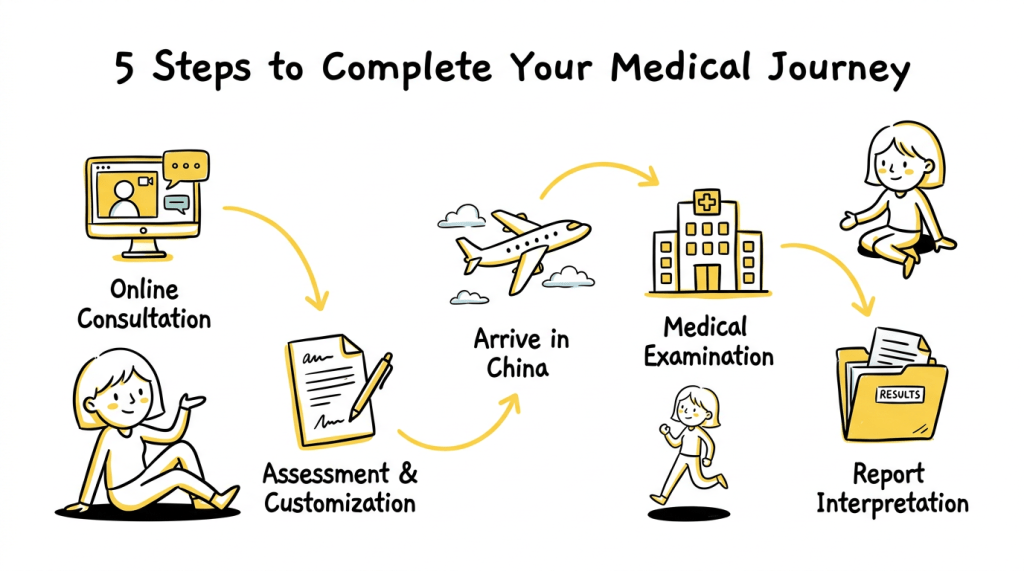
They are designed for high-volume, high-efficiency screening without compromising accuracy.
- One-Stop Shop: You arrive at the Health Management Center. You complete blood work, imaging (CT, MRI, Ultrasound), specialist consults, and functional tests all in one location.
- Speed: Most routine results are available within 24 hours. Imaging reports often within 24-48 hours.
- Technology: Access to advanced screening tools (like low-dose CT for lungs, MRI for brain/abdomen) is immediate. There is no queue for “non-urgent” scans because the system is built for throughput.
- AI Integration: Tools like PANDA can scan routine CTs for early-stage cancers that humans might miss. This adds a layer of safety to your screening.
The Result:
In 2 days, you can complete a comprehensive screening that might take 3 months elsewhere.
This is the “Short, Flat, Fast” advantage.
It converts uncertainty into data.
And data allows you to make decisions.
The Visa & Travel Integration: The 144-Hour Opportunity
China’s immigration policies have opened a unique window for this type of care.
The 144-Hour Visa-Free Transit Policy allows citizens of many countries (including US, UK, Canada, EU) to enter major hubs (Beijing, Shanghai, Guangzhou, etc.) for up to 6 days without a visa, provided you have an onward ticket to a third country.
How This Works for Health:
- Day 1: Arrive in Shanghai. Check into hotel near the hospital.
- Day 2: Full health screening (fasting blood work, imaging, consults).
- Day 3: Receive reports. Doctor interprets results. Plan follow-up if needed.
- Day 4-6: Light tourism or rest before onward flight.
Why This Matters:
- Cost-Effective: You are already traveling. Adding a checkup marginal cost is low compared to flying specifically for care.
- Time-Efficient: It uses layover time productively.
- Low Barrier: No visa application stress for short stays.
This transforms a transit stop into a health security checkpoint.
It is self-added insurance.
You are not waiting for the system to call you. You are proactive.
East vs. West: Understanding the Screening Philosophy
It is important to understand the cultural difference in screening.
- Western Model: Often conservative. Avoids over-testing. Focuses on guidelines based on age and specific risk factors. Good for avoiding unnecessary procedures, but can miss early anomalies in complex cases.
- Chinese Model: Often comprehensive. Prefers early detection through broad screening (e.g., whole-body MRI, tumor markers). Good for catching “silent killers” early, but requires expert interpretation to avoid false alarms.
The Balanced Approach:
When you travel for a checkup, you get the best of both.
You get the comprehensive data of the Chinese model, paired with the expert interpretation needed to filter noise.
This is why using a facilitator is critical.
We do not just book the test.
We ensure the right tests are chosen for your risk profile.
We ensure the results are translated accurately (using terms like Incidental Finding, Follow-up, Benign from the medical lexicon).
And we ensure you have a plan for Continuity of Care when you return home.
The Process: What to Expect
A professional health checkup journey follows a tight protocol.
Phase 1: Pre-Arrival (Risk Profiling)
- We review your family history and current concerns.
- We customize the package. (e.g., If you have a family history of liver cancer, we add specific liver MRI and marker tests).
- We verify visa eligibility.
Phase 2: The Screening Day (Efficiency)
- Morning: Fasting blood draw, ultrasound, CT/MRI.
- Afternoon: Specialist consults (Cardiology, Internal Medicine, etc.).
- Logistics: You are guided from station to station. No queuing. No confusion.
Phase 3: The Report (Clarity)
- Translation: You receive an English summary.
- Interpretation: A doctor sits with you to explain findings.
- Benign? You leave with peace of mind.
- Requires Attention? You have a plan immediately (treatment in China or follow-up at home).
- Incidental Finding? We clarify if it needs action or just monitoring.
- Archive: You keep digital copies for your home doctor.
Risk Management: Accuracy & Follow-Up
The biggest fear with overseas checkups is: What if they find something serious? Am I stuck?
This is where professional support changes the outcome.
- Accuracy: We select hospitals with international accreditation and advanced pathology labs. False positives are minimized through expert review.
- Immediate Action: If something is found, you are already in the system. You can access treatment immediately. You do not have to go home and wait again.
- Continuity: If you choose to return home for care, we provide a full translated dossier for your local physician. We bridge the gap.
Case Example:
A client transited through Beijing. He added a lung CT screening.
The AI system flagged a small nodule.
In his home country, this might have been “watch and wait” for a year.
In Beijing, a specialist reviewed it immediately.
It was deemed low-risk, but he was given a specific 6-month follow-up plan.
He flew home with certainty, not anxiety.
He knew exactly what to watch.
That peace of mind is invaluable.
Key Takeaway
Health is not just the absence of disease.
It is the presence of knowledge.
In a world where waiting lists are long and economic stability is shaky, taking control of your health data is a strategic move.
China’s medical infrastructure offers a unique combination of speed, technology, and accessibility.
By integrating a health checkup into your travel plans, you are not just sightseeing.
You are auditing your most valuable asset.
You are turning uncertainty into a managed plan.
You are insuring yourself against the unknown.
Action Step:
Next time you plan a trip to Asia, consider adding 48 hours for health.
Contact us to design a screening package that fits your transit window.
Because the best time to fix a problem is before you know it exists.
 DrHerbs